

What to do in Cordoba with children?
If you want to spend a weekend in Cordoba capital with your children, in Alojamientos Turísticos we bring you a series of…
Read More by administrador
Walking through Cordoba is a delight for all the senses, the beauty of its streets, the pleasant smell of its courtyards and we can not ignore the history, represented in every corner of this beautiful city.
In Cordoba are represented the three religions that at one time in history were the protagonists: Jewish, Arabic and Christian.
In addition to Roman archaeological remains, traces of a past that we can still observe, thanks to its conservation. Among these artistic manifestations are the gates of Cordoba, architecture with history, which remain intact.
Well, in this beautiful city there are “doors” that give entrance to squares and emblematic places, very appreciated by the Cordobeses and Cordobesas, that from AT we trust in the great surprise that you will take with you who visit them.
The oldest in the city. Its name is due to the fact that this gate was the communication with the Cordovan town of Almodovar del Rio, located 23 kilometers from the capital of Cordoba.
Built in the Arab period, it has undergone modifications. In the 14th century, two towers were added to the original building, which are joined by a pointed arch, giving rise to a high barrel vault. The material used for its construction was sandstone masonry with added brick and ashlar. In spite of having been modified, it is one of the three oldest gates that has been remodeled the least. Located in the historic center of Cordoba, which was declared a World Heritage Site by UNESCO in 1994.
Beautiful name that honors one of the main entrances to the Jewish Quarter both from Dr. Fleming Street and from the Alcázar Viejo.
Located just three hundred meters from the Puerta de Almodóvar. It was created in 1960 by the architect José Rebollo, who after the remodeling of the area in the 14th century, added the moat and the interior walkway of the wall to reach Luna Street, which until then was a dead end.
Crossing the passageway of this beautiful gate, we arrive at a small square, where we will find a fountain dedicated to the God of Bread, with the sculpture of a child playing the flute, made by Rafael García Rueda, a sculptor who used the face of his son for it. In front of the fountain you will be able to see a column crowned by the Virgin of the Moon in iron.
Due to various circumstances it is currently closed, but it can be seen from the outside.
In the past it was known as Puerta de Algeciras, as it was the gateway for those coming from the south of Andalusia.
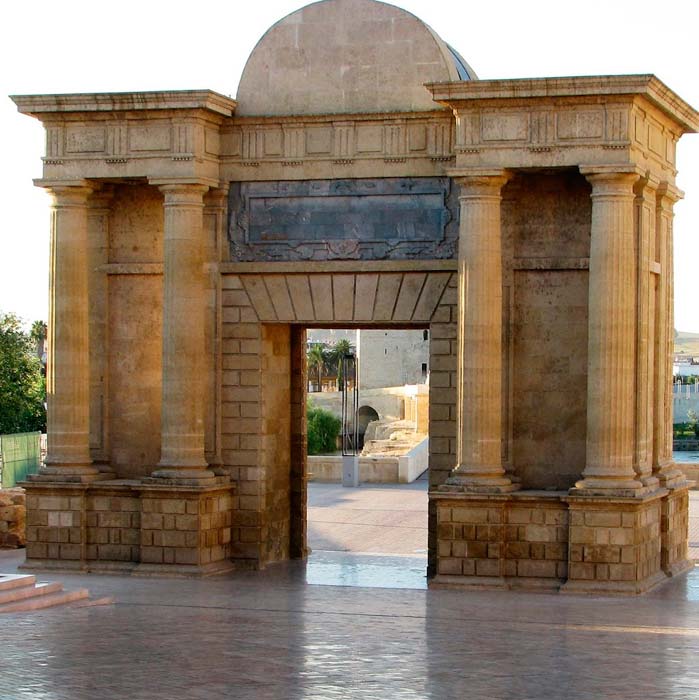
As a result of the visit of King Philip II in the sixteenth century, it was remodeled to give it its current image. Built in three sections, the two ends are closed with four fluted columns, leaving in the center the linteled opening crowned by a simple curved pediment. Located at one end of the Roman Bridge, this gate is one of the most visited, being one of the most photographed monuments of the city.
To enter the famed San Basilio neighborhood, one must pass through the Seville Gate. Its name was given to it in the Middle Ages, for being the road that communicated with the Andalusian city. It is not very big in size, but it has many architectural details that you will like. Composed of a single linteled span, it has two twin arches attached to the wall perpendicularly. Its construction date is estimated in the Muslim period, probably the main function was military.
Now that you know a little more about the history of Cordoba, do not hesitate to visit it. Come and enjoy a weekend in our vacation rental apartments. Located in the center of Cordoba with all the comforts.

Walking through Cordoba is a delight... Read More

If you want to spend a... Read More
Since 2010 flamenco is Intangible Cultural... Read More
Thank you so much
I blog often and I truly appreciate your information. This great article has truly…

Join The Discussion